How Speak reinvents language learning
March 24, 2026
.png)
At Speak, we combine state-of-the-art AI technology with language pedagogy. Our learning design team, made up of highly experienced educators and researchers, collaborates with engineers and designers to make sure you not only get hooked on language learning, but that you actually learn to speak.
What is the Speak Method?
The Speak Method is our proprietary learning method built around three phases: Learn, Practice, and Apply.
Learn exposes you to a realistic scenario and the phrase patterns native speakers actually use in it. By "phrase patterns," we don't mean textbook sentences you'd find in a phrasebook. Think of them more as flexible building blocks you can mix and match. And the best part? By learning and practicing phrase patterns, you’re actually picking up vocabulary and grammar in context as a chunk without having to painfully memorize words and grammar rules one by one like you probably did in school.
Rather than memorizing "I'd like a coffee, please," you learn the pattern "I'd like ___" and can immediately apply it to dozens of situations: "I'd like the window seat," "I'd like a salad," "I'd like the check." Grounding these patterns in a specific scenario, like checking into a hotel or navigating a job interview, gives them context that makes them more meaningful and easier to remember. And we only teach authentic language, the kind speakers actually use, never stiff textbook phrasing.
.png)
Practice overlaps with the Learn phase. You start speaking the new patterns right away, then move into more structured repetition to build muscle memory and gain mastery. It's the longest phase because it's the core of learning: you drill until the phrases become part of you.
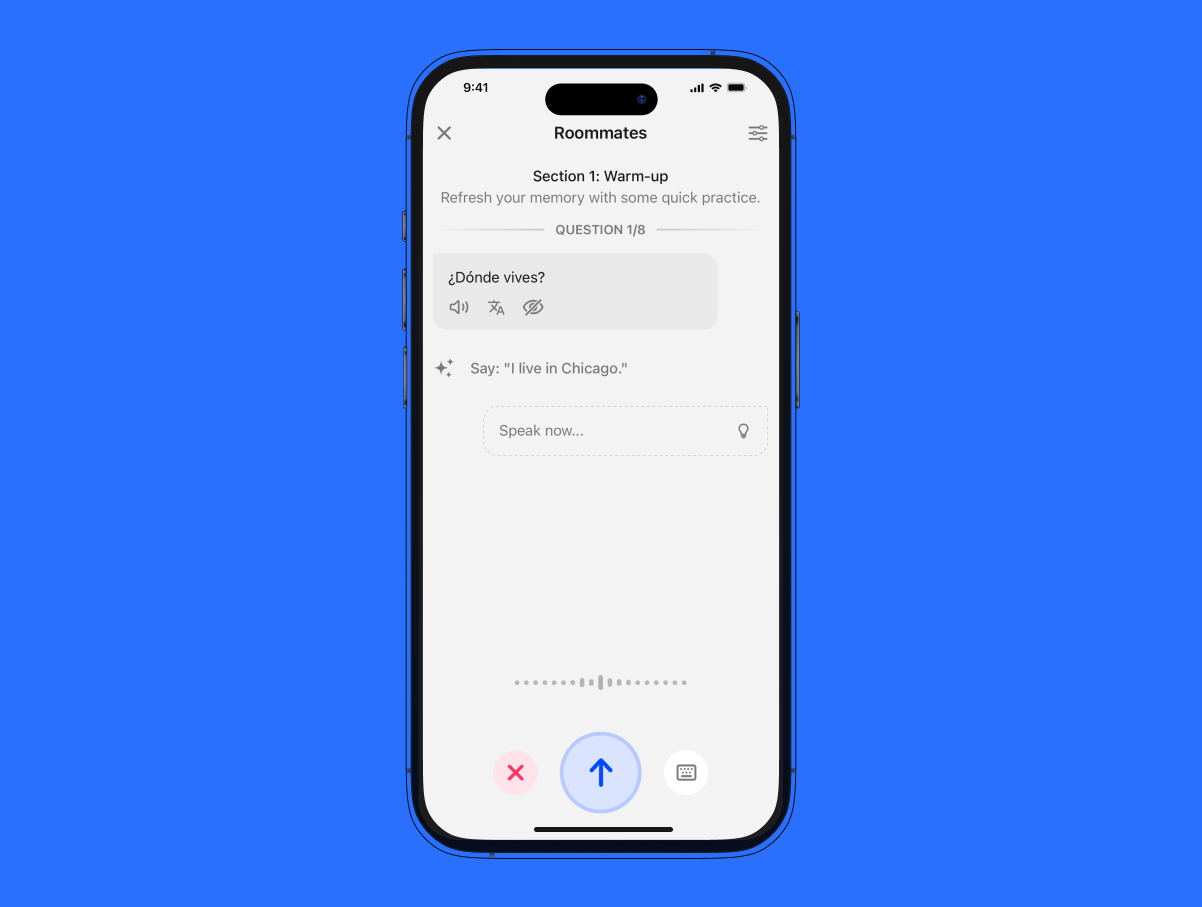
Apply is where you put it all to the test. You have to use what you learned in a real-time conversation with AI, no script and no word bank. It's like talking to a real person, but without the social pressure. And you get immediate feedback on how to improve your responses.
Why does the Speak Method work?
Natural language is inherently spoken, and even in this highly digital age, most real communication still happens out loud. Learners who come to Speak recognize this, and it's what makes our experience unique: we get you speaking within 10 seconds of starting your first lesson.
Why? Because speaking is a highly complex mental process, and the more you practice it, the more automatic it becomes. That automaticity frees up mental bandwidth, so instead of struggling to construct a sentence, you can focus on what you actually want to say. You're building muscle memory.
On top of building fluency through actual speaking, Speak helps learners improve accuracy through immediate, personalized feedback. If you say "I am go to the store yesterday" in a role-play lesson, the app doesn't just flag it as wrong. It models the correct form in context and gives you a chance to try again.
Accuracy matters, but Speak intentionally prioritizes building speaking confidence and fluency early in the learning journey. Accuracy training is layered on top of that fluency later. This is because focusing too much on accuracy upfront can actually hurt motivation, introduce foreign language anxiety, and slow down fluency development.
Many traditional methods, and even many apps today, rely largely on passive learning: grammar explanations to read, blanks to fill in, sentences to reorder. This doesn't help you get a feel for the language or develop on-the-spot speaking skills, and it feeds anxiety about making mistakes. At Speak, we encourage learners to just speak and not worry about being perfect. Language is a skill. It's more like learning to drive than learning to do math. Your body needs to learn it through experience.
How do we build language curriculum at Speak?
Behind every Speak lesson is a team of former teachers turned ed-tech builders. Our learning designers are polyglots with formal training in language education. Before transitioning into tech, many of us taught in classrooms all over the world. We share backgrounds in applied linguistics and teaching, and most importantly, a deep love of language learning.
But what truly shapes our work? We've all been language learners ourselves. We know what it feels like to freeze up mid-sentence, to forget a word, to feel intimidated in a real conversation. That lived experience gives us empathy, and it drives every decision we make.
As Natalia, one of our Lead Learning Designers, puts it: "There's something incredibly motivating about helping so many people gain confidence in a new language. We feel empowered by our mission to teach the entire world in an empathetic, effective, and efficient way."
How does a course come to life?
Every course starts the same way: with learners.
We study how people use Speak, run interviews, analyze feedback, and test ideas. We look for what's working, what's missing, and where learners are getting stuck. From there, we zoom out. What real-world situations should this course prepare you for? How does it fit into the rest of our content? What should you actually be able to do by the end?
We define clear communicative goals, themes (like travel, business, or reconnecting with family), and the core phrase patterns you'll need. Then learning designers, as well as Speak’s internal curriculum design AI come together to refine the plan, challenge each other, and sharpen the goals until we have the best curriculum for Speak’s users.
As we embrace AI-powered curriculum and learning experiences, our obsession with quality has only increased. A single 4-unit course can include 50+ lessons and takes weeks of writing, revising, filming, testing, and polishing. Before anything reaches you, we review every script, every interaction, every detail in the app. It's not just curriculum design. It's teamwork across writing, video production, editing, QA, and experimentation.
Designing for different learners around the world
Designing courses isn't a one-size-fits-all endeavor.
Learners studying English often arrive with years of classroom study behind them but little to show for it in actual speaking ability, and a very real need for the language, for school, for work, for life.
English-speaking learners studying other languages often come with different motivations: travel, romance, cultural connection, or just a love of learning. Their goals are diverse and deeply personal.
That diversity makes our job more complex, and more exciting. What stays constant: we follow the Speak Method, we put learners first, and we stay relentlessly curious, always testing, improving, and innovating.
We believe language brings worlds together. That belief guides everything we build.