Live tutor lessons, powered by OpenAI's GPT-Live-1
September 10, 2026
.png)

A great language tutor knows when to give you room to think, and when a little help will get you speaking.
When you're learning a language, a pause rarely means the same thing twice. Sometimes you're hunting for a word. Sometimes you're rethinking the sentence. Sometimes you just need a beat to work up the nerve to keep going. A good tutor reads the difference: staying quiet when you need space, dropping in a hint when you're stuck, letting you land the sentence yourself instead of finishing it for you. That's good, personalized teaching.
Today we're introducing the first version of Live Tutor Lessons, powered by OpenAI's GPT-Live-1. It brings that kind of support into Speak's lessons. Each one has a clear goal, practice built around your own life, and a tutor that can help while you're mid-answer.
A more present tutor
GPT‑Live-1's low latency and continuous listening help the tutor respond to those moments naturally. It can acknowledge a learner without cutting in, leave room to think, and offer a hint to help them continue.
In one live test, a learner paused for several seconds during a lesson, and the tutor offered a hint without being asked, just enough support to help them continue.
But natural conversation alone does not make a great language lesson. The harder challenge is giving learners that freedom while keeping the interaction grounded in what they need to learn.
Designed to invite participation
Through user interviews and live testing, we learned that interrupting a tutor does not come naturally to many learners. Making it possible to ask a question was only part of the work. We needed to design lessons that actively invited participation.
We evolved the lessons around that finding, deliberately creating moments where the tutor checks understanding and asks learners to think and answer in their own words. The learner shouldn't have to speak up first to get an interactive lesson.
Speak defines what learners need to practice and accomplish, while GPT‑Live-1 adapts the conversation to what each learner says. Within that teaching goal, the learner's context can shape the language they actually learn and practice. In a lesson about work, for example, they can practice describing their own job and responsibilities.
Learners can also ask unexpected questions or get a simpler explanation along the way. The conversation stays open-ended, but Speak gives it direction.
Teaching the tutor when to respond
One of the most encouraging findings from our early evaluations was that framing GPT‑Live-1 specifically as a language tutor materially changed its behavior.
When the model was configured as a generic assistant, it interrupted 27.6% of learner thinking pauses in the evaluation. When we provided the role and context of a language tutor, that rate fell to 13.6%.
On pauses lasting between one and two seconds, a common amount of time for someone searching for a word, the tutor interrupted fewer than 10% of the time while still beginning its response about one second after the learner finished.
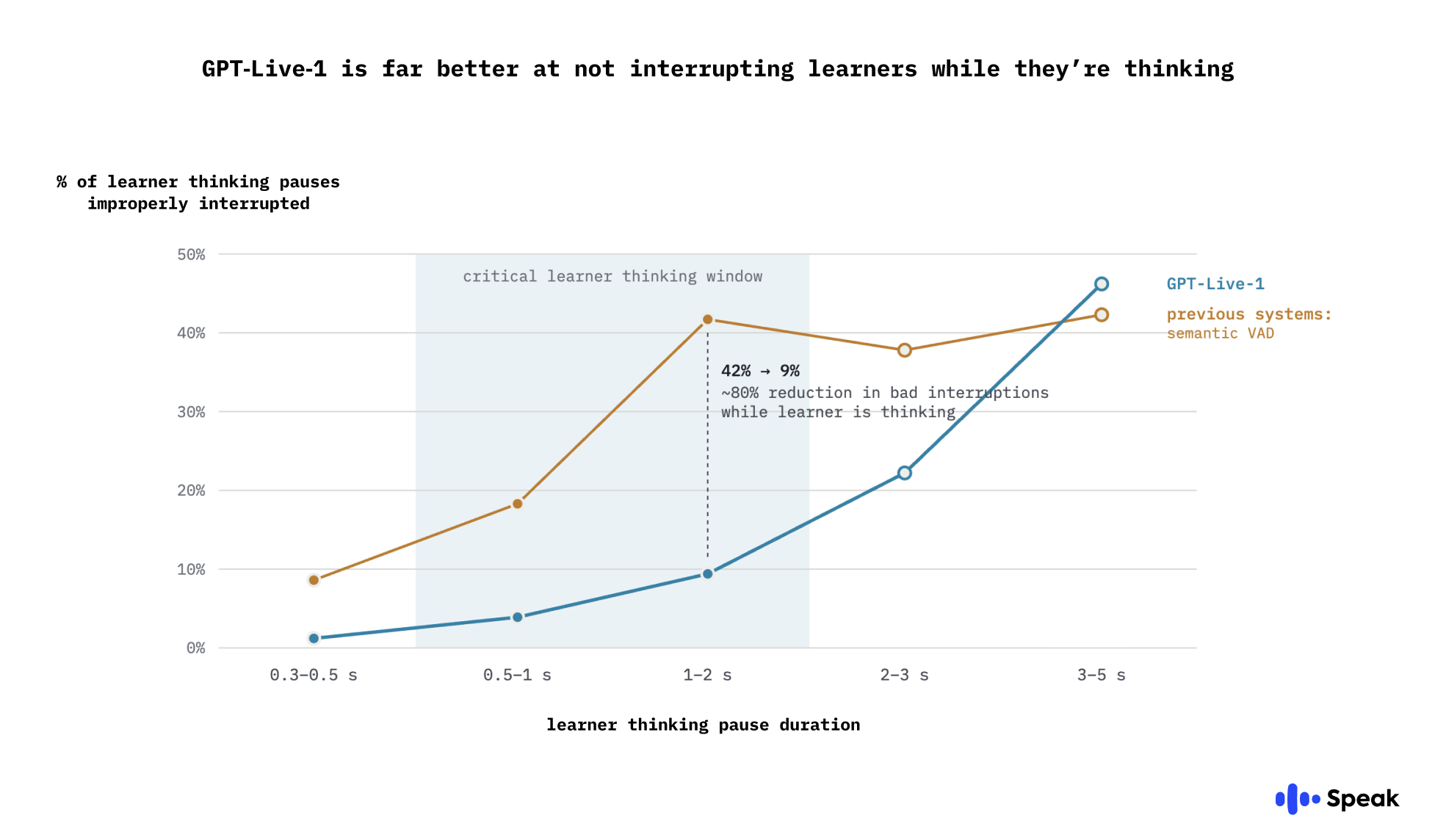
Language learners need room to hesitate, but they shouldn’t be left waiting once they’re done. The challenge is knowing when to keep listening, when a hint would help, and when the learner is ready for a response.
Our pedagogy gives the interaction purpose and direction, and GPT‑Live-1 makes it feel natural and responsive.
Flexibility without losing the lesson
Lessons invite learners to answer in their own words, and learners can also ask questions or take the conversation somewhere unexpected. We needed to know whether the tutor could follow those turns while still carrying through the lesson’s instructional progression.
We built an end-to-end evaluation system to test that question. GPT‑Live-1 conducted complete lessons with a simulated learner. That learner participated in practice, answered questions, and introduced interruptions at different points. Our team then measured whether the tutor returned to the lesson and delivered its authored instructional elements.
Across 27 complete evaluation sessions, GPT‑Live-1 delivered 476 of 477 authored lesson lines, maintaining the lesson’s progression through open-ended practice, learner questions, and lessons of up to 32 steps.
Completing the authored material was only part of what we measured. We also looked at how the tutor adapted along the way. When its wording changed, it usually adjusted transitions or coaching language to fit the conversation.
That is the combination we have been working toward: enough freedom for the conversation to feel real, with enough guidance for the experience to remain a lesson.
What Speak’s pedagogy makes possible
A tutor also needs to decide whether a correction will actually help.
Correcting every imperfection is not good teaching. A learner might be asking for clarification, or expressing confusion, or simply communicating successfully despite a minor error. An unnecessary correction can derail the moment and make the learner lose confidence and the willingness to speak.
We evaluated whether GPT‑Live-1 could make that distinction during a conversation. Across 101 scored learner turns, roughly 85% of the model's corrections were warranted, and it caught about 80% of the targeted errors. It also correctly avoided corrections in all 12 evaluated cases where correction would have distracted from the learner's immediate need.
The results were not perfect. The model still missed some errors and occasionally offered stylistic feedback when the learner's language was already valid.
But its ability to consider conversational context, and not merely detect an error, suggests that meaningful teaching judgment can increasingly happen inside the live interaction.
Moving toward a personal tutor for every learner
Live Tutor Lessons bring us closer to a personal tutor that understands what each learner wants to say and helps them build the language to say it. Over time, we want that understanding to shape what learners study, how they practice, and how lessons build on one another.
We are beginning with a limited rollout for English and Spanish learners and will expand availability as we learn from real interactions. We will continue refining how the tutor teaches, supports learners, and keeps the conversation flowing.
The tutor we're building creates reasons to speak and gives you room to think. It helps you find the words that matter to you.